12 August 2009
A discourse on Expectations by Socrates & Plato
One Way To Find Out
This wisdom can be applied to situations both large and small. From crossing the Atlantic on a boat to trying Ethiopian food, there’s only one way to find out what it’s like. We have all had experiences where we tried something we didn’t think we’d like and fell in love. We may have found ourselves stuck with nothing to read but a "boring" book, only to kick-start a lifelong passion for Victorian literature. We may have decided that sailing was not for us until we fell in love with someone with a boat. On the other hand, we may try tofu only to learn that it is truly not for us. In this case, we gain greater self-knowledge from the experience. And yet, we might still remain open to trying it prepared in a different way. The right marinade might make you a convert—you’ll never know if you don’t try it.
It is often said that at the end of our lives we are more likely to regret the things we did not do than the things we did. As an exercise to test your own willingness to discover through doing, try making a list of things you regret not having done. You may begin to notice patterns such as a failure to say what you really think at key moments or closed-mindedness to certain types of activities. Just being aware of the opportunities you missed might encourage you not to miss them again. There’s only one way to find out.
~OM~
29 July 2009
Letting Your Light Shine
12 June 2009
Lansagin Upang Gawing Muli
Lahat tayo ay may kakilalang nakapagtaas ng proseso ng pagrereklamo bilang isang tinaguriang sining. Minsan nakakatawa, minsan nakakapagod, ang mga taong ito ay may kakayahang makahanap ng problema ukol sa lahat ng bagay kahit saan. Sa maiging uri ng salita, ang pagrereklamo lamang ay ang kakayahanag makakita kung ano ang hindi maayos, sa sariling buhay o sa panlabas na mundo, at ito ay maaaring maging lubos na kapaki-pakinabang kung susundin nito ang kanyang likas na konklusyon — ang paghanap ng solusyon at ilapat ito. Subalit, marami sa atin ang di pa nakakatunton doon, at napapatagtanto na ang pagrereklamo ay syang dulo na mismo nito. Sa mumunting dosis, hindi ito isang malaking problema, ngunit kung ang pagrereklamo ay naging isang malaking bahagi ng ating pagkatao o pagkakakilanlan, ito ay maaaring oras na upang magandang tingnan kung paano natin inilalagak ng maiigi ang ating panahon at enerhiya.Ang pagrereklamo ay isang paraan ng bawat isa na kilalanin na hindi sila masaya sa mga kaganapan ng mga bagay-bagay sa paligid nila o sa buhay nila. Sa isang metaporikong paraan, kapag tayo ay nagreklamo o namumuna, nais nating lansagin ang isang hindi kanais-nais na istraktura upang bigyang daan ang isang bagay na bago. Ngunit kung ang lahat ng ating gagawin ay magpilas lamang o manlasag ng kung ano-ano man, nang hindi man lang alalahaning atasan ang mapanlikhang enerhiya na kinakailangan upang lumikha ng bagong bagay, tayo ay hindi tumutupdan sa proseso ng progreso. Sa katunayan, tayo ay nasa panganib na maging isang hadlang at mapanirang puwersa sa ating sariling buhay at sa buhay ng mga mahal natin. Isa pang talakayin sa pagrereklamo ay tayo minsan ay napagdidiskitahan ang kapwa, na di natin mabago, bilang isang paraan upang lihisin ang pansin mula sa taong maaari nating baguhin—ang ating sarili. Kaya nga sa paraan ng pagbabago ng pagrereklamo upang maging isang bagay na kapaki-pakinabang ay prosesong may dalawang bahagi na nagsisimula sa pagbaliktad ng ating mapagpunang mata sa mga bagay na may maaari tayong gawin , at pagkatapos takdan ng positibong aksyon.
Kapag nakikita nating tayo’y nagrereklamo, ang huling bagay na kailangan nating gawin ay makuhang ibaba ang ating sarili. Sa halip, tayo’y maaaring magsimula sa pamamagitan ng pagpansin na tayo’y nasa paraan ng pagdahop na gumawa ng ilang mga pagbabago. Ngunit sa halip na manghagupit sa isang tao o ng isang organisasyon, maaari tayong humanap ng angkop na lugar upang ibambang itong enerhiya—hindi sa ating mga kapwa, ngunit posibleng bahagi ng ating mga sarili. Panghuli, maaari nating tanungin ang ating sarili ng positibong tanong na kung ano ang ating nais na likhain sa lugar nating gusting pilasin. Kapag ginawa natin ito, ating binabambang ang negatibong ugali sa isang malikhaing proseso, sa gayon ay ginagamit natin ang enerhiyang mabago an gating kapaligiran sa isang positibong paraan.
~OM~
04 June 2009
Minzhu Nushen
"At this grim moment, what we need most is to remain calm and united in a single purpose. We need a powerful cementing force to strengthen our resolve: That is the Goddess of Democracy. Democracy…You are the symbol of every student in the Square, of the hearts of millions of people. …Today, here in the People’s Square, the people’s Goddess stands tall and announces to the whole world: A consciousness of democracy has awakened among the Chinese people! The new era has begun! …The statue of the Goddess of Democracy is made of plaster, and of course cannot stand here forever. But as the symbol of the people’s hearts, she is divine and inviolate. Let those who would sully her beware: the people will not permit this! …On the day when real democracy and freedom come to China, we must erect another Goddess of Democracy here in the Square, monumental, towering, and permanent. We have strong faith that that day will come at last. We have still another hope: Chinese people, arise! Erect the statue of the Goddess of Democracy in your millions of hearts! Long live the people! Long live freedom! Long live democracy!"
- part of the declaration of the Chinese Art Students that created the statue in their quest for reform held at a rally made in Tiananmen Square
Fall of the Goddess
The soldiers were able to fulfill their timeline of reaching the Square on June 4, 1989 by 1 a.m. through the use of tanks and armored personnel carriers. The Goddess of Democracy had stood for only five days before being destroyed by soldiers of the People's Liberation Army in the assault on Tiananmen that would end the Democracy Movement. The toppling of the Goddess of Democracy was seen by millions across the world on television “pushed by a tank, it fell forward and to the right, so that its hands and the torch struck the ground first, breaking off." As the statue fell, protestors shouted "Down with Fascism!" and "Bandits! Bandits!" It was "quickly and easily reduced to rubble, mixing with all the other rubble in the Square. To be cleared away by the Army". By 5:40 a.m. a negotiated settlement allowed the remaining students to leave by the south-eastern corner of the square. The army had fulfilled its order to clear the Square by 6 a.m. Clashes continued throughout the city and in other towns across China.
And the blood poured through the streets of Beijing
Those Who Came Before Us

Many entities assume the role of spirit guide. Throughout our lives, we may call upon angels, animal and nature spirits, ascended masters, and celestial guardians for aid, protection, and support. Our ancestors represent another wellspring from which we may draw wisdom in times of need for they, too, can act as our spirit guides. Since our forbears spent at least one lifetime experiencing the tribulations that are a part of human existence, the perspective they can offer is a uniquely grounded one. Ancestral spirit guides can empathize with our fears and our frailties, worry, temptation, and feelings of insecurity. Once you have requested their guidance, they will see to it that you emerge unscathed on the far side of conflicts and are well-equipped to fulfill your potential.
If your relationship with your relatives was strained when they were earthbound or you feel disconnected from your heritage, the thought of asking your ancestors for aid can be disconcerting. But when the soul takes on its spirit form, it becomes pure light. Your ancestors, regardless of who or what they were in life, are monitoring your life’s journey because you are their progeny and they want to see you do your best. You can communicate with them directly, as well as through meditation, your dreams, or the written word. Creating an altar or shrine that displays images of your forbears or objects owned by them can help you connect with individual ancestors. The guidance they provide may take many forms as each ancestral spirit guide retains its individual identity and will thus have its own style of communication. If your ancestors do not speak to you directly or visit you in your dreams, examine your life to determine whether they are replying to your queries subconsciously.
When you make contact with your forbears, thank them for being a part of the web of intent that gave you life. Honoring their wisdom and experience can make your life seem larger and richer. Like other spirit guides, your ancestors won’t interfere with your choices or attempt to deprive you of free will. They will only do their best to answer your questions and provide you with all the love, aid, and guidance you ask for in order to help you evolve as an individual.
02 June 2009
Greeting the Divine Spirit
If you have ever bowed or been on the receiving end of a bow, you know that it is different from a handshake or a hug. Bowing has the quality of consciously evoking spirit and conveys a sense of reverence for the people involved. The word "Namaste," which accompanies bowing in yoga, actually translates as "The divine spirit in me acknowledges the divine spirit in you." When we greet one another with this kind of awareness, we can?t help but be more conscious that we are deeply connected to one another and to everyone, because this divine spirit resides in all of us.
22 May 2009
An Unwavering Connection to the Infinite
05 May 2009
Eros Ascending

by John Maxwell Taylor
The quest for lasting love is one of life’s essential pursuits, in some ways the most essential. But it’s also a quest that’s impossible to separate from spiritual and sexual needs. In Eros Ascending, author John Maxwell Taylor offers a wide-ranging study of sexual dysfunction in society and explains how healthy sexuality can be an entryway to universal love and higher consciousness. Based on Taylor’s twenty-three-year experience with Taoist practices, the book presents an engaging analysis of love, relationships, and sexuality from spiritual, romantic, and sexual perspectives. Taylor melds essential ideas by Jung, Gurdjieff, and Taoist Master Mantak Chia with science, biology, spiritual tradition, and current popular culture to shed new light on this eternal yet misunderstood subject. Not just for couples, the book is equally useful for single people who want to understand the methods for “learning to love yourself ” in preparation for a fulfilling, long-term relationship. Taylor draws on his eclectic background as a successful playwright, composer, actor, and musician in this persuasive plan for converting ordinary sexual energy into food for the soul.
Excerpt:
Why Is It Scary Below the Waist?
If you (or anybody else) were to go to a teacher who had attained divine consciousness and asked to become his or her devotee, the teacher would probably give you meditation techniques for concentrating on the so-called “third eye” at the point between the eyebrows. There might also be concentration on the crown of the head, or at the heart center. But rarely will you find a genuine teacher who would direct a new student to concentrate upon the area of the body below the navel. The reason for this is that the centers of intelligence in the lower part of the body (the three so-called “lower chakras”) are connected directly to the subconscious mind.
When we are out and about, engaged in daily activities, our eyes are usually looking straight ahead, or left or right. We are operating in the so-called “conscious” mode of operation. However, sitting to meditate, we would probably raise our eyes gently upward, toward the third-eye point between the eyebrows, attempting to lift our mental awareness toward higher consciousness. When we sleep at night our eyes go downward as we descend into the subconscious mind to pass the nocturnal hours wandering in our dreams. So the reason the teacher gets the student to focus upon the frontal lobes of the brain and the upper half of the body is to get him or her centered, and established in a strong connection with the higher dimensions of consciousness first. Later, at an appropriate time, if the teacher truly knows what he or she is doing, the student will be led to gradually direct attention downward, toward the lower part of the body. Having previously made a connection with the “higher self,” it might be possible to open up and heal all the disowned parts of the personal self one had to leave behind for a while in order to get established in higher consciousness.
For the student who does not successfully undertake this re-entry into the earth’s atmosphere (the lower body with its innate grounding capabilities), after circling in outer space through meditative detachment from it, the entire structure of spiritual development could come crashing down. Can we build a superstructure of light on an unsafe foundation? Remember the man who built his house upon the sand and, when the wind blew, down it came and great was the fall of it? But the other man, who built his house on rock, found that it was able to withstand anything that life threw at it. That “rock” is a balanced and integrated subconscious mind.
This felicitous state can be attained when we successfully open up the lower part of our nature and purify it through loving acceptance of what we may have been seeing as the dark side of our humanness. According to the Psalmist, to God, the darkness and the light are both the same. Understanding the hidden divine nature of our primal selves, which may initially appear to us as dark and scary, is the solid ground upon which we can build our everyday lives with a firm foundation. Once this is accomplished, we can live secure in the knowledge that nothing can shake us, break us, or throw us off track.
When we are securely established in this manner, our sexual force can be used to fertilize our physical health and mental equilibrium, and create thought-children of insight and inspiration, ideas that can revolutionize our entire approach to life. Instead of seeing the body and everyday life as an impediment to our personal happiness, we become useful to our-selves and our world. We are able to serve as conduits through which healing energy and clarity can enter into our daily activities. Then we can truly aid human evolution at a high level of conscious world service.
01 May 2009
Seat Of Life
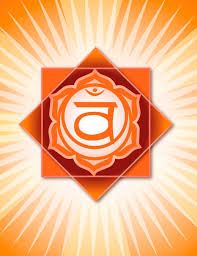
When we have gained a deep understanding of the body and soul, there often follows a desire to reach out, to grow, and to change. In the Vedic texts, the second chakra, the energy center between the navel and genitals, is the seat of life and the house of change. It is a point where opposites come together in sympathy, guiding us toward a balanced existence. The choices that help us evolve are often a product of the second chakra, which, when charged with neither too little nor too much energy, rejects rigid control and embraces creativity. Associated with taste and sensuality, the second chakra or Svadhisthana (which means sweetness) can be visualized as a brilliant sunset orange. Like its element, water, the second chakra is ruled by the moon.
A weakness or imbalance in the second chakra can lead to feelings of extreme empathy, which can cause you to be ruled by the emotions of others. To fail to focus on this chakra leads to the opposite: an utter lack of emotion and dwindling passions. A balanced second chakra embraces both sides of everything, giving you a healthy understanding of your emotions as well as those of others. Nurturing it through dance, laughter, and pleasurable movement will help you embrace your own sexuality, which is the main aspect of the chakra. Stimulation of the second chakra can be achieved through the use of orris root, gardenia, or damiana incense; practicing tantra yoga; or exposing the chakra to moonstone or coral. These methods of opening and energizing the chakra can be performed individually or in tandem for greater effect.
The second chakra may appear a route to indulgence to some, because of its focus on the feelings of the body, but it is also the dwelling place of the self. A fully functioning second chakra, working in a balanced way with the body’s other chakras, is a source of self-knowledge and understanding.
~OM~